


Why Bubble Wrap Supplier Reliability Is Non-Negotiable
If you're importing bubble wrap into the U.S., reliability isn't a "nice to have" - it's the whole game. A single weak link in your bubble wrap supply chain can turn a smooth operation into a damage-claim nightmare.
Hidden Risks of Unreliable Bubble Wrap Suppliers
When a packaging material supplier cuts corners, it shows up fast in the real world:
- Inconsistent bubble size – Some rolls are over-inflated, some under-inflated. That means uneven protection, crushed bubbles in transit, and higher damage rates.
- Weak seals and poor air retention – If the seals between bubbles are thin or sloppy, the air leaks out before your shipment even reaches the DC. Cushioning drops, impact resistance disappears.
- Frequent defects – Torn film, stuck layers, bad winding, uneven bubble wrap thickness – your team wastes time tossing bad rolls and rewrapping orders.
On paper, the bubble wrap looks cheap. In reality, you're paying for it in rework, returns, and angry customers.
Real-World Consequences for Your Reputation
For importers, bad bubble wrap isn't just a packaging issue - it's a brand risk:
- Delayed shipments while your team scrambles to re-pack damaged items
- Spikes in returns, replacements, and freight claims
- Negative reviews blaming you (not your bubble wrap supplier) for "poor packaging"
- Retail and marketplace partners questioning your reliability
You might have solid products and strong logistics, but if the protective packaging fails, your customer doesn't care why. They just see a broken item and a brand they can't trust.
How a Reliable Packaging Vendor Changes the Game
When we switched to a truly reliable packaging vendor for our own imports, the impact was immediate:
- Consistent bubble wrap quality: Stable bubble wrap uniformity, strong seals, and verified air retention on every batch
- Reduced product damage: Fewer breakages in transit, especially on fragile and high-value SKUs
- Happier customers: Higher delivery satisfaction scores, fewer "item arrived damaged" complaints
- Cleaner operations: Less rework, smoother warehouse flow, and more predictable shipping
That's why I treat bubble wrap evaluation criteria and importer packaging selection as a strategic decision, not a quick price comparison. A reliable bubble wrap supplier protects more than your products - it protects your margins, your ratings, and your reputation.
Criterion 1: Material Quality and Standards
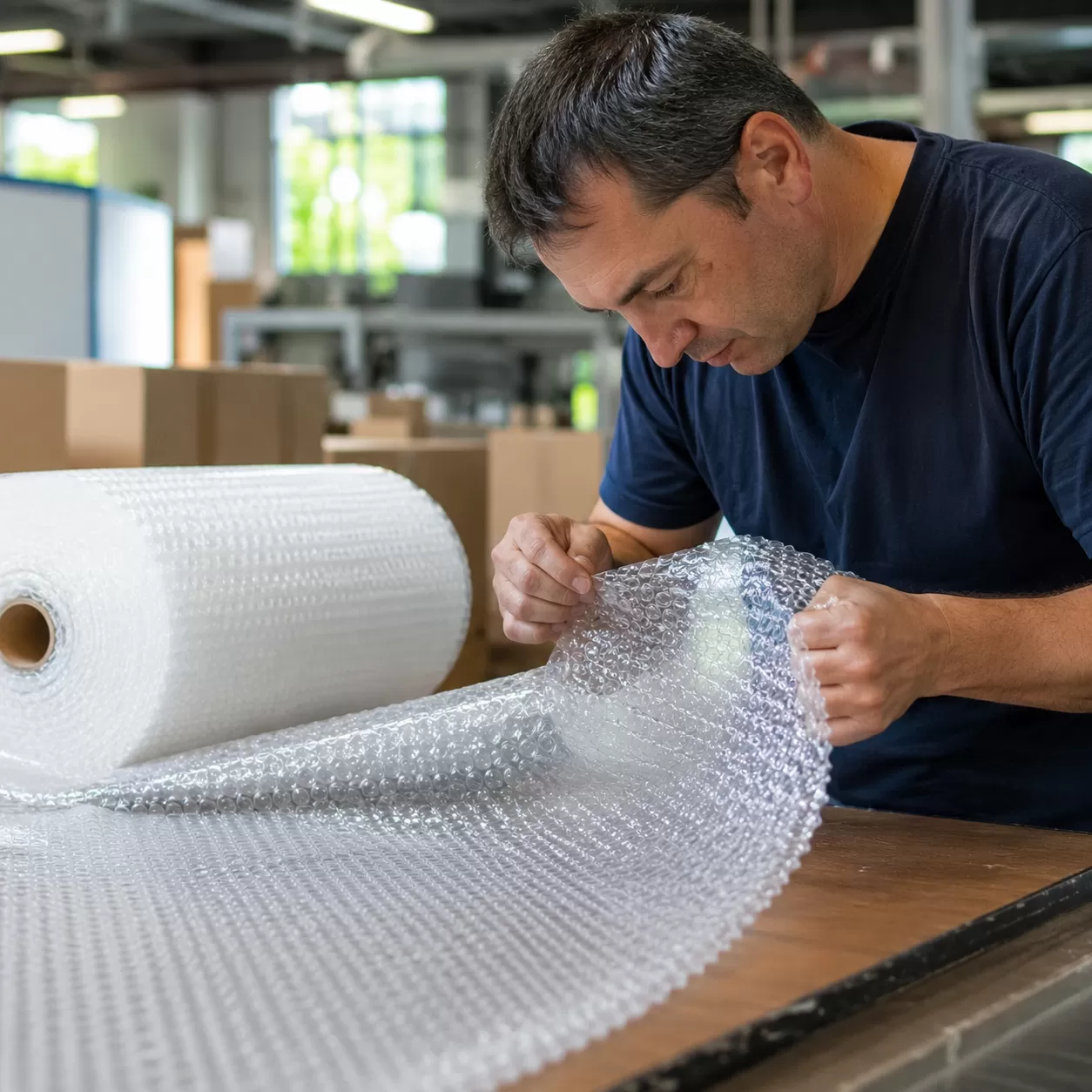
When I evaluate bubble wrap suppliers, I start with material quality. If the film is weak or the bubbles leak air, nothing else really matters.
Polyethylene Bubble Wrap Specifications (Microns & Mils)
For most U.S. importers, polyethylene bubble wrap specs come down to two basics:
- Film thickness
- Light duty: 40–50 microns (about 1.6–2.0 mils)
- Standard duty: 50–70 microns (about 2.0–2.8 mils)
- Heavy duty: 80–100+ microns (about 3.1–4.0+ mils)
Ask the supplier for:
- Clear spec sheets listing thickness in microns and mils
- Tolerance range (e.g., ±5%) so you know how much variation to expect
- Whether they use virgin PE, recycled PE, or a blend
For fragile or higher-value items, I always pay for thicker film and better bubble wrap quality. Thin film might look similar at first, but it fails fast under real shipping pressure.
Bubble Uniformity & Sealing Strength
Good cushioning comes from uniform bubbles and strong seals, not just thickness.
Check for:
- Uniform bubble size across the roll (no flat or over-inflated bubbles)
- Consistent sealing lines with no gaps or weak spots
- Bubbles that don't collapse after basic compression
Simple on-site checks:
- Press and release a strip in your hand – bubbles should bounce back, not stay flat.
- Bend and twist the sheet – seals shouldn't split easily.
- Compare samples from different rolls in the same shipment to spot inconsistency.
If you also use mailers or padded solutions, compare how their bubble quality matches with more advanced options like honeycomb-lined mailers to keep your packaging standards consistent.
Reading Lab Reports & Air Retention
A reliable packaging material supplier should share lab reports on:
- Air retention over time (how much pressure the bubbles hold after 24/48/72 hours)
- Puncture resistance and tensile strength
- Compression performance (how much force before the bubbles fail)
What to look for:
- Test standards listed (e.g., ASTM methods)
- Clear numbers, not vague claims like "good air retention"
- Consistent results across multiple batches
Quick way to verify air retention yourself:
- Cut a sample, date it, and store it in normal warehouse conditions.
- Check after 24–72 hours:
- Have the bubbles softened or gone flat?
- Is protection noticeably weaker compared to day one?
If the supplier can't back up their bubble wrap with hard data and stable air retention, I treat that as a major red flag and move on.
Criterion 2: Certifications and Compliance
When I evaluate a bubble wrap supplier, certifications and compliance are non-negotiable. If they can't prove they meet the right standards, I move on.
Key certifications importers must verify
For reliable bubble wrap quality and global supply chain packaging, I always ask for documentation on:
- ISO 9001 – Shows the factory has a real quality management system, not just talk.
- ASTM standards – Especially for polyethylene bubble wrap performance (tear strength, cushioning, durability).
- REACH compliance – Critical if you're moving product into the EU; confirms restricted chemicals are controlled.
- FDA compliance – Important if the bubble wrap is used around food, cosmetics, or sensitive consumer goods.
I ask for current certificates, test reports, and third-party audits-then verify the lab or agency is legitimate.
How certifications cut risk and customs delays
Proper bubble wrap compliance does three big things for importers:
- Reduces legal liability – If a customer claims your packaging is unsafe or non-compliant, you can show documented standards.
- Prevents customs problems – Certified materials are less likely to trigger inspections, re-testing, or seizures.
- Supports smoother audits – Retailers, marketplaces, and big-box chains in the U.S. increasingly demand proof for all packaging material suppliers.
This is where I use certifications as a filter: if a supplier hesitates to share them, that's a red flag for the entire relationship.
Protecting end customers with compliant bubble wrap
Reliable bubble wrap quality isn't just about fewer damage claims-it's also about safety and brand trust:
- No harmful chemicals leaching from the film.
- Verified bubble wrap thickness and performance for fragile goods.
- Safer contact with items like snacks, gifts, and specialty foods (similar to how food gift wrap applications must meet strict standards).
When a reliable packaging vendor shows strong compliance and testing, I know I'm not just protecting my shipments-I'm protecting my customers and my brand reputation in the U.S. market.
Criterion 3: Production Capacity and Manufacturing Process
When you're importing bubble wrap into the U.S., production capacity and the actual manufacturing process are what decide whether your supply chain runs smooth or stalls out.
Assessing Factory Capacity and Modern Production Lines
A reliable bubble wrap supplier should prove they can keep up with your demand without cutting corners on quality.
Key things I check:
- Monthly output & peak capacity
- Ask for current monthly tonnage/roll output and what they can handle during peak months (Q4, promo seasons, new product launches).
- Number and age of production lines
- Modern, automated lines = more stable bubble wrap quality, better bubble wrap uniformity, and fewer defects.
- Backup equipment & maintenance
- Do they have backup lines if one goes down?
- Regular maintenance schedules or just "fix it when it breaks"?
If they produce other cushioning materials (like air pillows, foam, or even recycled shredded paper for packaging), it's a good sign they're invested in protective packaging, not just reselling bubble wrap.
Quality-Control Protocols for Consistent Bubble Wrap Quality
Capacity means nothing if the quality swings from batch to batch. For bubble wrap quality, I want to see:
- Standard operating procedures (SOPs)
- Written specs for bubble wrap thickness (microns/mils), bubble size, sealing strength, and roll length.
- In-line inspections
- Operators checking bubble uniformity, seal integrity, and film clarity during production, not just at the end.
- Lab tests & records
- Regular tests for:
- Film thickness and tensile strength
- Seal strength (so bubbles don't pop in transit)
- Air retention over time
- Ask for recent QC reports tied to batch numbers.
- Regular tests for:
A serious packaging material supplier will show you test reports without hesitation and use them to improve their process.
Scaling Reliably During Peak Import Seasons
U.S. importers feel the crunch during Black Friday, Christmas, and big promo campaigns. This is where manufacturer due diligence really matters.
Before you lock in a bubble wrap supplier, confirm:
- Forecasting & production planning
- Can they reserve capacity for you based on a 3–6 month forecast?
- Lead time guarantees
- Clear standard lead times and realistic "peak season" lead times-written into your contract.
- Priority policies
- How do they prioritize orders when everyone is busy? Long-term partners should get priority queueing.
- Contingency plans
- Backup raw material suppliers
- Alternate plants or partner facilities if one location has issues
When I evaluate a custom bubble wrap supplier, I treat this like an insurance policy for my global supply chain packaging: if demand spikes or shipping lanes get messy, they still keep product moving without sacrificing bubble wrap thickness or protection.
Criterion 4: Pricing Models and Value for Money
When I choose a bubble wrap supplier, I never look at unit price alone. For importers, "cheap" can get expensive fast. You need to calculate the total landed cost of your bulk packaging material and the true cost of ownership over time.
Moving Beyond Unit Price: Total Landed Cost
For bubble wrap, I always factor in:
- Product cost: Price per roll or per square foot (including different bubble wrap thickness options).
- Freight & duties: Ocean/air freight, customs duties, brokerage fees, port charges.
- Packaging efficiency: Higher-quality bubble wrap with better bubble wrap uniformity often reduces usage per shipment.
- Damage rate impact: If weaker bubble wrap leads to more returns or replacements, your real cost per order jumps.
A quick way to compare suppliers:
- Take annual usage (sq ft or rolls).
- Add product cost + all logistics + duties.
- Add an estimated "damage cost" (claims, reships, labor).
- Divide by the number of parcels shipped to get real packaging cost per order.
Volume Discounts, MOQs, and Hidden Fees
Reliable packaging material suppliers should be upfront about:
- Volume discounts: Ask at what breakpoints (e.g., 1 pallet, 3 pallets, 1 container) the price drops.
- Minimum-order quantities (MOQs): Check if MOQs match your storage space and cash-flow reality.
- Hidden fees: Pallet fees, packaging fees, documentation fees, rush charges, storage fees at the port.
I always ask for a written quote that clearly breaks out:
- Unit price
- Freight terms (FOB, CIF, DAP, etc.)
- Extra charges and payment terms (deposit %, balance timing, penalties)
12-Month Cost of Ownership Framework
For a 12‑month contract, I use a simple framework to judge value for money:
- Annual spend = (Unit price × annual volume) + all logistics & duties
- Operational cost = Storage, handling, any special equipment
- Quality cost = Product damage rate, customer complaints, returns
- Flexibility value = Ability to scale up/down without heavy penalties
Put this into a basic spreadsheet and compare suppliers side by side. Sometimes a slightly higher bubble wrap quality cost per unit saves thousands in reduced damage, lower freight (more efficient packaging), and fewer customer headaches.
If you're also sourcing other packaging (like branded or eco lines), you can apply the same cost framework to things like eco-friendly wrapping paper rolls to keep your entire packaging budget under control.
Criterion 5: Logistics and Delivery Performance
When I'm choosing a bubble wrap supplier, I treat logistics and delivery performance as seriously as bubble wrap quality. If the packaging doesn't show up on time, nothing else matters.
Evaluating Lead Times, Network Coverage, and Shipping Reliability
For U.S. importers, I always look at:
- Standard and peak lead times
- Ask for normal lead time, peak-season lead time, and emergency lead time.
- Check how they handle port congestion, holidays, and unexpected demand spikes.
- Distribution network coverage
- Do they have U.S. warehouses or 3PL partners on the East and West Coast?
- Can they deliver to multiple fulfillment centers or Amazon FBA locations without delays?
- Shipping reliability metrics
- On-time delivery rate (aim for 95%+).
- Frequency of short shipments or partial deliveries.
- Their process to notify you early if a shipment will be late.
If you're also using paper-based options alongside bubble wrap, a supplier that can support multiple packaging formats (for example, those offering kraft gift bags with handles or food wrapping paper like on this packaging range) often has more mature logistics and stocking capabilities.
Tracking Transparency and Global Supply Chain Packaging Challenges
Global supply chain packaging is messy if you can't see where your freight is. I only trust packaging material suppliers who:
- Provide real tracking (not just "it shipped")
- Forwarder details
- Container or airway bill numbers
- Live ETA updates
- Share proactive logistics communication
- Early alerts about delays or customs risks
- Alternatives if a route or port is disrupted
- Understand U.S. import rules
- Correct HS codes for bubble wrap
- Clean documentation to avoid customs holds
The Value of Reliable Ocean or Air Freight Partners
Your bubble wrap supplier doesn't need to be a freight forwarder, but they must work with reliable ocean and air partners:
- Ocean freight for bulk packaging material
- Best for large-volume polyethylene bubble wrap orders
- Lower cost per unit, but you need predictable schedules and strong carrier relationships.
- Air freight for urgent or first-time orders
- Ideal when launching a new product or fixing a stockout
- Higher cost, but protects your sales and reputation when timing is critical.
I always check whether the supplier can:
- Offer multiple Incoterms (FOB, CIF, DDP)
- Ship from different ports to avoid bottlenecks
- Support mixed loads (bubble wrap + paper packing products) to cut freight costs
If a bubble wrap supplier can't deliver consistently, they're not a reliable packaging vendor-no matter how good their bubble wrap thickness or price looks on paper.
Criterion 6: Customer Service, Support, and Long-Term Partnership
When I choose a bubble wrap supplier for my imports, I treat customer service and support as seriously as material quality. A "cheap" supplier that ghosts you when there's a problem will cost you far more in returns, delays, and bad reviews.
Responsiveness and Technical Support
A reliable bubble wrap supplier should feel easy to reach and easy to work with:
- Fast response times: You should get quotes, sample confirmations, and shipment updates within 24 hours or less.
- Clear technical assistance: They should help you match bubble wrap thickness, bubble size, and roll width to your actual products (electronics, furniture, cosmetics, etc.).
- Problem-solving mindset: When there's an issue-defects, short shipments, wrong specs-they offer solutions, not excuses.
Ask them directly:
- What's your average email response time?
- Do you have a dedicated account manager for US importers?
- Can you help with packaging optimization, not just selling rolls?
Effective Complaint Handling and After-Sales Support
Any packaging material supplier can look good when everything goes right. The real test is how they handle problems:
- Clear claims process: You should know exactly how to report defects (photos, batch numbers, timelines).
- Documented corrective actions: Good suppliers share what they'll change in production or QC to prevent repeat issues.
- Compensation policies: For serious quality failures, they should offer replacements, credits, or partial refunds.
I treat strong after-sales support as proof the supplier is confident in their bubble wrap quality and willing to stand behind it-same mindset I look for when reviewing a broader buying guide for packaging materials like this pre-purchase checklist for packaging quality and reliability.
Long-Term Partnership With a Custom Bubble Wrap Supplier
For US importers, the real win is turning a reliable packaging vendor into a long-term partner:
- Custom bubble wrap options: Printed logos, specific bubble wrap thickness, anti-static bubble wrap for electronics, or tailored roll sizes for your packing stations.
- Forecast-based planning: Sharing 6–12 month forecasts so they can lock in raw materials, production slots, and freight space, especially before Q4 and other peak seasons.
- Continuous improvement: Regular reviews on:
- Damage-rate reduction
- Cost per shipped unit
- Packing speed and labor efficiency
When a custom bubble wrap supplier understands your SKUs, channels (Amazon FBA, DTC, wholesale), and damage tolerance, they stop being "just a vendor" and become part of your operations team-keeping your shipments protected, your customers happy, and your supply chain stable.
Sustainability Considerations for Modern Importers
Eco‑friendly bubble wrap trends
If you're importing into the U.S., sustainability is no longer "nice to have" - it's part of how big retailers, Amazon, and DTC customers judge your brand.
Here's what I look at when choosing sustainable bubble wrap:
- Recycled-content bubble wrap
- Made with post-consumer or post-industrial polyethylene.
- Cuts virgin plastic use while keeping familiar performance.
- Ask suppliers for recycled percentage, source, and third‑party verification.
- Biodegradable or compostable bubble wrap
- Usually made from special additives or plant-based films.
- Better fit for brands with strong ESG marketing, especially in food, cosmetics, or gifts.
- Always check actual degradation conditions (industrial composting vs. home composting).
If you also use paper-based void fill or cushioning, pairing sustainable bubble wrap with eco-friendly honeycomb-lined mailers can create a more consistent green unboxing experience.
Meeting ESG requirements without losing performance
For most U.S. importers, the key is hitting ESG goals without more damage claims:
- Make sure sustainable bubble wrap still meets your bubble wrap thickness, bubble uniformity, and air-retention requirements.
- Run side‑by‑side tests:
- Drop tests at typical shipping weights
- 24–72 hour compression tests in cartons
- Ask your packaging material supplier for lab data on cushioning performance and aging, not just "eco" marketing.
Done right, sustainable bubble wrap helps you:
- Check ESG and retailer scorecard boxes
- Reduce plastic footprint
- Keep your damage rate steady or lower
Balancing sustainability and protection
I always treat sustainability as a performance-plus, not a trade‑off:
- Start with critical SKUs (electronics, glass, cosmetics) and test sustainable bubble wrap first.
- Use premium sustainable materials for fragile products, and standard recycled bubble wrap for less sensitive goods.
- Combine sustainable bubble wrap with other eco options like food-safe wrapping paper or recyclable outer packaging when it makes sense.
The goal is simple: protect the product first, then optimize the footprint. When you push suppliers on both sustainability and performance, you get packaging that keeps customers happy and supports your ESG story at the same time.
Practical Checklist: 7 Steps to Evaluate Any Bubble Wrap Supplier

When I'm qualifying a bubble wrap supplier, I follow the same simple 7-step checklist every time. You can treat this like a quick worksheet for importer packaging selection and run it with every new vendor.
1. Define Your Bubble Wrap Specs Clearly
Before you ask for quotes, lock in your basic requirements:
- Material: standard polyethylene, anti-static bubble wrap, or eco-friendly options
- Bubble wrap thickness: e.g., 3/16″, 5/16″, 1/2″, and film thickness in microns/mils
- Bubble wrap quality needs: electronics, fragile glass, heavy parts, etc.
- Roll width, length, perforation, custom printing, or custom bubble wrap sizes
If the supplier can't repeat your specs back clearly, they're not ready.
2. Request Documentation and Certifications
For any serious packaging material supplier, I ask upfront for:
- ISO quality certificates
- Test reports for bubble wrap uniformity and sealing strength
- Any REACH/FDA compliance if products touch food or sensitive goods
No certificates or "we'll send later" is a red flag before a packaging supplier audit.
3. Order Physical Samples and Test Them
Never skip samples. For bubble wrap evaluation criteria, I always:
- Check bubble size consistency across the roll
- Press, drop, and compress to see air retention over 24–72 hours
- Check seals between bubbles for weak spots or flat areas
You can compare bubble wrap to alternatives like honeycomb paper roll for certain SKUs if you're expanding your protective packaging mix: honeycomb paper roll protective packaging.
4. Verify Manufacturing and Capacity
Make sure you're talking to a real manufacturer, not just a middleman:
- Ask for factory photos, production line details, and staff count
- Ask monthly capacity and their peak-season lead times
- Confirm they can scale if your U.S. orders double or if you add new product lines
If possible, schedule a video tour or third-party packaging supplier audit.
5. Break Down Pricing and Total Landed Cost
Don't just chase the lowest unit price. For bulk packaging material, I always ask:
- Unit cost per roll or per square foot at different volumes
- MOQs, sample fees, mold/plate fees for custom printing
- Estimated freight cost, import duties, and any extra handling fees
Build a simple 12-month "true cost of ownership" sheet comparing 2–3 suppliers.
6. Evaluate Communication and Support
Reliable packaging vendors act like partners, not just sellers. During calls or emails, ask:
- Who is my dedicated contact, and what's their response time?
- How do you handle complaints or quality issues? (Replacement? Credit?)
- Can you help with packaging optimization for U.S. e-commerce or 3PL needs?
Pay attention to how fast and how clearly they answer.
7. Ask Targeted Questions on Calls or Visits
Here are sample questions I use during supplier calls, factory visits, or audits:
- "What's your defect rate on bubble wrap rolls over the last 12 months?"
- "How do you control bubble size and thickness during production?"
- "Can you share two U.S. client references and recent on-time delivery rates?"
- "How quickly can you ship if we have an urgent replenishment order?"
You can reuse a similar question format when you evaluate other packaging, like custom kraft bags with logo for branded shipments: custom kraft bags with logo.
Run every potential bubble wrap supplier through this 7-step checklist, document the answers, and you'll quickly see who is reliable enough to protect your products and your reputation.
Common Pitfalls to Avoid When Choosing a Bubble Wrap Supplier
1. Chasing the Lowest Unit Price and Ignoring Bubble Wrap Thickness
If a packaging material supplier is offering prices way below market, they're cutting somewhere-usually on bubble wrap thickness, film quality, or air retention. That's where your damage rate and returns start climbing.
Watch out for:
- Thin film (low microns/mils) that pops easily under normal handling
- Overly soft bubbles with poor air retention
- No clear spec sheet for bubble wrap quality and thickness
Always match price to specs and performance, not just to a spreadsheet. Saving a cent per foot means nothing if you're losing dollars on damaged shipments.
2. Skipping Samples and Reference Checks
Never lock into a bulk packaging material contract without touching and testing the product. Ignoring physical samples and reference checks is one of the fastest ways to get burned.
Before you sign anything:
- Request multiple bubble wrap samples (different thicknesses and bubble sizes)
- Do simple tests: squeeze, drop-test with your product, check sealing strength and bubble uniformity
- Ask for U.S. customer references and confirm on-time delivery and real-world performance
If they dodge samples or references, move on. A reliable packaging vendor will push you to test first.
3. Missing Red Flags: Middleman vs. Real Manufacturer
A lot of "factories" online are just traders. That's a big risk when you care about bubble wrap quality, custom specs, and stable supply.
Red flags that you're dealing with a middleman:
- They can't provide factory photos, videos, or certifications in their own name
- Lead times keep changing because they're juggling multiple upstream suppliers
- Technical questions about polyethylene bubble wrap, bubble wrap thickness, or production lines get vague answers
Ask directly:
- "Can I do a factory audit or video tour?"
- "Whose name is on the production certificates and test reports?"
- "Are you producing other protective packaging, such as shredded paper void fill, in-house as well?"
A true custom bubble wrap supplier will be transparent about their machines, QC process, and production capacity. Middlemen won't.
Case Studies: Real Importers Who Got It Right
Profile 1: Cut Damage Claims by Fixing Bubble Wrap Uniformity
One of our U.S. electronics importers was bleeding money on damage claims-over 6% of their shipments arrived with crushed corners or cracked casings. When we audited their packaging, the problem was obvious: thin polyethylene bubble wrap, inconsistent bubble size, and weak seals that leaked air during transit.
We switched them to a higher bubble wrap thickness, tightened bubble wrap uniformity, and ran lab checks on sealing strength and air retention before mass production. Within one quarter:
- Damage claims dropped from 6% to under 1.5%
- Customer complaints about "poor packaging" nearly disappeared
- Their warehouse team reduced repacking and rework time by over 30%
The result: better protection, fewer returns, and a stronger brand reputation on marketplaces like Amazon and Walmart.
Profile 2: Smoother Logistics with a Reliable Packaging Material Supplier
Another importer, focused on home goods, struggled with global supply chain packaging chaos-late shipments of bubble wrap, stockouts before peak season, and inconsistent roll sizes from a trading company posing as a manufacturer.
We onboarded them to our reliable packaging vendor network, aligned forecasts, and locked in production capacity ahead of Q4. Key changes:
- Stable lead times with buffer stock near their U.S. DCs
- Standardized roll widths that matched their packing lines
- Clear documentation for customs and bubble wrap compliance
Logistics costs fell because they stopped overpaying for emergency air shipments and last‑minute substitutes. Their overall packaging cost per shipped unit dropped by about 12% over 12 months.
If you're also shipping fragile items like chocolates or glassware, pairing quality bubble wrap with the right cushioning-such as specialized cushion pads for chocolate boxes-can deliver the same kind of measurable improvement.
Measurable Wins from Rigorous Bubble Wrap Supplier Selection
When importers treat bubble wrap evaluation criteria seriously instead of chasing the cheapest roll, the numbers move fast:
- Lower total damage rate and fewer chargebacks from retailers
- Shorter packing times thanks to consistent, easy‑to-use rolls
- More predictable supply chains because the packaging material supplier actually has capacity and controls production
In the U.S. market, where customers expect fast shipping and perfect condition on arrival, choosing a reliable bubble wrap supplier isn't optional-it's a competitive advantage.
Frequently Asked Questions (FAQs)
1. How do I know if the supplier is a real manufacturer or just a middleman?
To tell if a bubble wrap supplier is a real manufacturer, I always verify:
- Factory details: Ask for the full factory address, photos, and a live video call on the production floor.
- Production capability: Request info on extrusion lines, bubble wrap machines, and daily/weekly capacity. A middleman usually can't answer in detail.
- Certifications and reports: Real manufacturers have ISO certificates, test reports, and can put your company name on new reports.
- Invoices & contracts: Check if the legal entity on the invoice matches the factory info.
- Visits or third‑party audits: If possible, arrange a visit or use an inspection company to confirm it's a working plant, not a rented office.
2. What bubble size and thickness should I start with for electronics?
For importer packaging selection in electronics, I recommend starting with:
- Bubble size:
- Small bubbles: 3/16″ (5mm) – best for phones, tablets, small devices, PC components.
- Bubble wrap thickness:
- Common range: 60–80 microns (about 2.4–3.1 mil) for retail-ready electronics.
- Go thicker (up to 100 microns / 4 mil) for heavier or higher-value devices.
Always test samples with your actual products and shipping method (parcel vs. pallet vs. ocean). Combine bubble wrap with inner box fillers, like high-performance brown paper filler, for better drop protection.
3. Does anti-static bubble wrap cost more, and when is it necessary?
Yes, anti-static bubble wrap typically costs more than standard polyethylene bubble wrap because of the special additives and testing involved.
You should use anti-static bubble wrap when:
- Packing PCBs, computer parts, chips, servers, gaming consoles, or any ESD‑sensitive electronics.
- Shipping to customers with strict ESD or electronics-handling standards.
- Selling to OEMs, tech brands, or government/medical buyers who require documented anti-static packaging material.
If your electronics are simple, low-value, and not sensitive to ESD (e.g., basic chargers), regular high-quality bubble wrap may be enough-but confirm with your product engineers or suppliers.
4. How can I test bubble wrap samples for sealing strength at home?
You don't need a lab to do basic bubble wrap quality checks. Here's a quick DIY test:
- Squeeze test: Fold a piece, press hard with your palm for 20–30 seconds. Weak seals will pop easily or lose air fast.
- Tape pull test: Stick packing tape over the bubbles, yank it off fast. Poor sealing or weak film will tear or flatten.
- Drop test:
- Wrap a fragile item (like a glass or a dummy electronic) in 2–3 layers.
- Drop it from 3–4 feet multiple times (corner, flat side, edge).
- Inspect for damage or heavy marking.
- Overnight air retention: Inflate a few bubbles (if possible) and mark them. Leave overnight. If they noticeably soften, air retention is poor.
Run these tests on all new samples before locking into a bulk packaging material contract or long-term bubble wrap supplier agreement.