

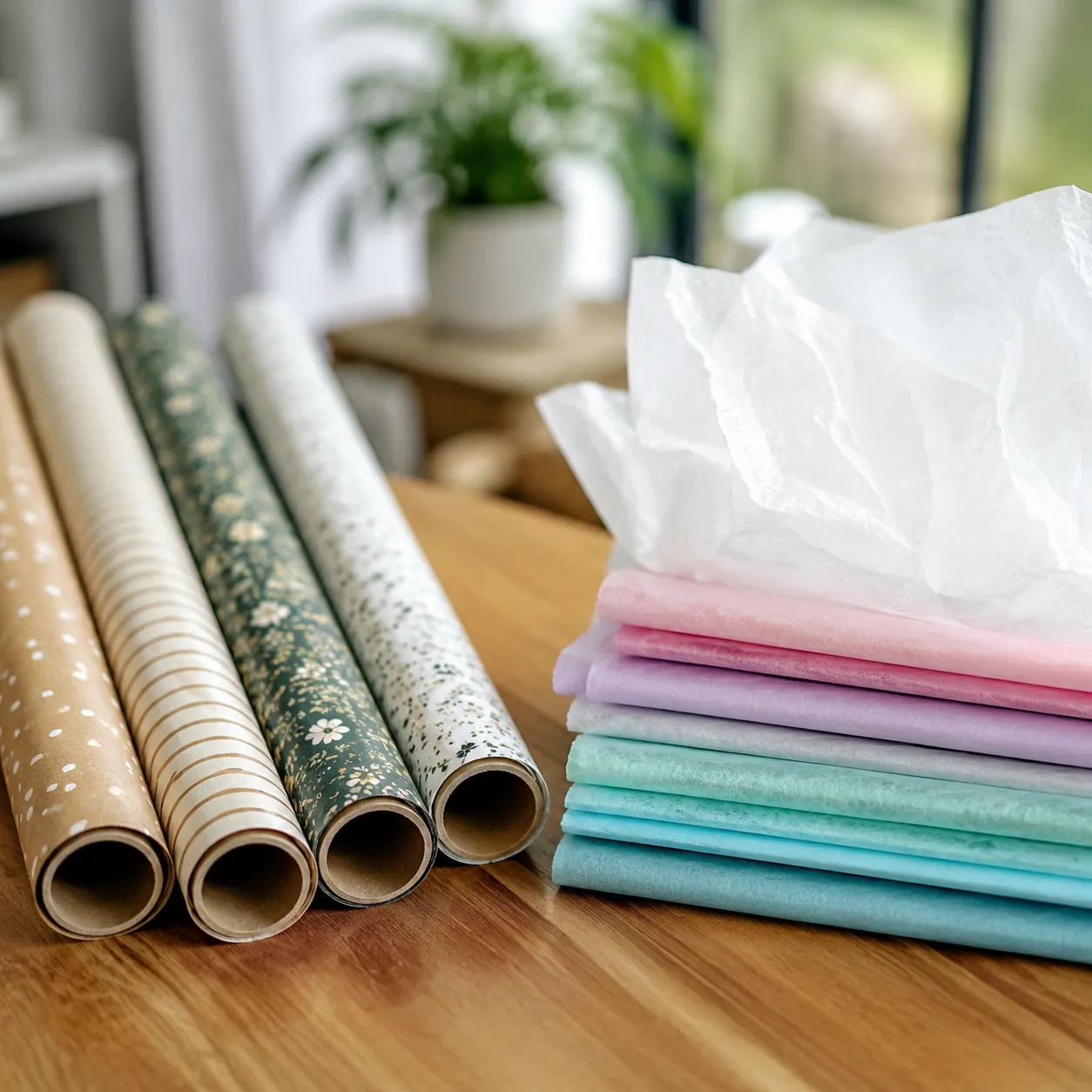
Understanding the Two Essentials of Gift and Product Packaging
If you sell physical products, you've probably asked yourself: Should I use wrapping paper or tissue paper-or both? The "wrapping paper vs tissue paper" question directly affects your product protection, unboxing experience, sustainability, and overall packaging cost. Getting this choice right is now a core part of building a modern, eco‑conscious brand.
Why the wrapping paper vs tissue paper question matters now
Today's customers expect more than just a box. They look for:
-
- Clean, professional presentation that feels on‑brand
- Reliable protection during shipping and shelf display
- Eco‑friendly materials instead of plastic fillers
- Consistent packaging across retail, e‑commerce, and wholesale
That's where understanding the difference between gift wrapping paper vs tissue paper becomes critical. Each material plays a very different role in your packaging system.
Quick definition: what is wrapping paper?
Wrapping paper is a stronger, more opaque paper used as the outer layer of gift and product packaging. In business packaging, this can mean:
-
- Branded gift wrapping paper around retail products
- Kraft wrapping paper or butcher‑style paper wrapped around items for extra surface protection
- Custom printed sheets used to create a premium, unified look
Wrapping paper is designed to hold its shape, carry print and color well, and provide a solid visual "shell" around your product or inner packaging.
Quick definition: what is tissue paper?
Tissue paper is a lighter, thinner, often semi‑translucent paper used mainly as an inner layer. In real packaging setups, that usually means:
-
- Soft tissue paper for gift packaging inside boxes or bags
- Delicate interleaving sheets between products to prevent scuffs
- Branded tissue that creates a luxury, layered unboxing experience
Tissue paper focuses more on presentation and light surface protection, while wrapping paper focuses on structure and outer appearance. Understanding this core difference between tissue paper and wrapping paper is the first step to building smarter, more sustainable packaging for your brand.
Material composition and physical properties

Fiber structure and manufacturing differences
Wrapping paper and tissue paper start with similar fibers, but they're built very differently.
-
- Wrapping paper
- Usually made from kraft or white base paper
- Fibers are more compact and strongly bonded
- Can be engineered as food‑grade (for chocolate gift wrap, butcher paper, etc.)
-
Often calendered (pressed) for a smoother, denser surface
- Made with a lighter, more open fiber structure
- Designed to be soft, flexible, and semi‑translucent
- Often used as inner wrap or decorative layer
- Can be produced as glassine‑type liners when extra grease resistance is needed
This structural difference is what makes wrapping paper feel "solid" and tissue paper feel "airy" and delicate.
GSM and thickness comparison (wrapping vs tissue)
GSM (grams per square meter) is a simple way to compare paper weight and thickness.
| Paper type | Typical role | Approx. feel |
|---|---|---|
| Tissue paper (thin) | Inner gift wrapping, fillers | Very light, easy to crumple |
| Standard gift wrapping paper | Retail gift wrap, boutique wrapping | Medium weight, flexible |
| Kraft wrapping / butcher paper | Shipping wrap, food‑grade wrap | Heavier, more rigid |
| Honeycomb paper rolls | Protective wrap, void fill | Expands into 3D cushioning |
We use these GSM ranges to tune performance: lighter for presentation, heavier for protection.
Durability, tear resistance, and surface performance
In real use, the big difference between wrapping paper vs tissue paper is how they perform under stress.
-
- Wrapping paper
- Higher tear resistance and better puncture resistance
- Holds up to shipping friction, stacking, and handling
- Surface can be smooth for high‑quality printing or slightly textured for kraft aesthetics
-
Ideal for outer wraps, food gift wrapping, and kraft shipping wraps
-
Tissue paper
- Lower tear resistance, tears easily if used alone outside
- Excellent for scratch protection on finished surfaces (cosmetics, electronics, fashion)
- Conforms tightly around products, giving a premium unboxing feel
- Works best as a decorative and protective inner layer inside boxes or bags
As a manufacturer, we design our wrapping paper, tissue paper, and honeycomb paper so you can match fiber structure, GSM, and durability to the exact job-whether that's boutique gift wrap, food‑grade packaging, or protective shipping applications.
Primary Functions: Protection vs Aesthetics
Wrapping paper as the protective outer layer
When we talk about wrapping paper vs tissue paper, wrapping paper is your first line of defense. It's designed to be the outer shell:
-
- It hides the product, protects it from scuffs, and keeps the structure of the package.
- Kraft wrapping paper and food gift wrap hold up better against handling, stacking, and light impact.
- For shipping, kraft-style wrapping or butcher‑type paper gives you more strength than tissue alone.
As a manufacturer, we use heavier, more durable papers for outer wrap so brands get better protection without jumping to plastic mailers.
Tissue paper as the decorative and protective inner layer
Tissue paper comes in as the inner layer that adds softness and style:
-
- It's lighter, semi‑translucent, and ideal for gift packaging and boutique unboxing.
- It cushions the product, prevents surface scratches, and fills small gaps inside boxes.
- Custom printed tissue with your logo or brand colors creates a premium, "boutique" feel.
In short, wrapping paper protects the outside, tissue paper elevates the inside.
When wrapping paper alone is enough
Wrapping paper on its own is usually enough when:
-
- The product isn't fragile (books, apparel, boxed items).
- You're using sturdy boxes or honeycomb paper around the item.
- You need fast, simple retail gift wrap at the counter.
Here, a solid kraft wrapping paper or printed gift wrap can handle both protection and presentation.
When tissue paper is essential
Tissue paper becomes essential when:
-
- The product surface scratches easily (jewelry boxes, cosmetics, polished items).
- You want that "luxury unboxing experience" with layered reveal.
- You're packaging multiple small items in one box and need soft separation.
For boutiques, e‑commerce brands, and subscription boxes, tissue paper for gift packaging is a core part of the customer experience.
Combining wrapping paper and tissue paper for maximum impact
The strongest setup is often wrapping paper + tissue paper together:
-
- Use wrapping paper or kraft as the outer layer for structure and protection.
- Line the inside with tissue paper for cushioning and visual impact.
- Add honeycomb paper or cushion paper pads when you need extra protection for fragile or heavy goods.
This layered approach keeps packaging functional, branded, and eco‑friendly, and it's exactly how we design paper solutions for US retailers, e‑commerce brands, and small businesses looking to replace plastic and upgrade their packaging.
Industry applications and use cases
Retail gift wrapping and boutique packaging
In retail and boutique packaging, the difference between wrapping paper and tissue paper shows up fast. For front-of-house gift wrapping, I rely on kraft wrapping paper or printed gift wrap as the outer layer because it has enough strength to handle handling, shopping bags, and transport. Inside the bag or box, I use semi‑translucent tissue paper to wrap the product, add color, and create a smoother, more premium unboxing moment. Branded tissue for boutique packaging lets you print logos or patterns, so every customer touchpoint stays on-brand while still using eco‑friendly, recyclable paper.
E‑commerce and fulfillment packaging
For e‑commerce and fulfillment packaging, wrapping paper vs tissue paper comes down to how far and how rough the shipment will be. For heavier products or US shipping networks where parcels take a few hits, I lean on kraft wrapping paper for shipping, honeycomb packaging paper rolls, or cushion paper pads as the main protective wrap or void fill. For lighter items and apparel, tissue paper for gift packaging works great as an inner wrap inside boxes, mailers, or kraft paper mailer alternatives, especially when the focus is a clean, branded, and plastic‑free packaging experience.
Food‑grade wrapping and specialty applications
In food and specialty applications, you can't just choose based on aesthetics; you need food‑grade wrapping paper and the right certifications. For chocolate and candy, I use chocolate gift wrap paper or glassine‑style liners that meet food-contact standards such as FDA and QS, so the product stays safe and grease doesn't bleed through. For fresh meat, freeze meat butcher paper and food‑safe butcher paper give you strength, moisture and grease resistance, and compliance with ISO22000-level food safety systems. Tissue paper here is more for outer presentation, not direct food contact, so I always keep it as a secondary, decorative layer.
Protective inner packaging for fragile and heavy goods
For fragile and heavy goods, wrapping paper vs tissue paper is really about structure. Tissue paper alone is not enough for weight and impact; I use it mainly to prevent surface scratches. The real protection comes from kraft paper rolls, protective honeycomb wrapping, and paper‑based void fill alternatives that lock items in place and absorb shocks during transit. Honeycomb paper cushions products without plastic bubble wrap, and cushion paper pads offer extra layers where corners and edges need more defense. This setup keeps shipping plastic‑free while still delivering the durability and low damage rates that US brands and warehouses expect.
Sustainability, Recyclability, and Environmental Impact

Fiber life and recyclability: wrapping paper vs tissue paper
From a sustainability angle, both wrapping paper and tissue paper can be eco‑friendly, but how they're made and used matters.
-
- Wrapping paper (especially kraft wrapping paper) is usually stronger, denser, and longer‑fibered, so it:
- Handles more reuse cycles (you can fold, store, and reuse it).
- Is typically easier to recycle in curbside systems when it's plain, uncoated, and plastic‑free.
- Tissue paper is thinner and more delicate, which:
- Limits how many times it can be reused.
- Can make recycling more challenging in some local facilities, especially if it's heavily dyed, glittered, or contaminated.
As a manufacturer focused on recyclable paper packaging, I always recommend choosing plastic‑free, ink‑controlled, FSC‑certified wrapping paper and tissue paper so both materials stay in the fiber loop as long as possible.
Composting, reuse, and low‑waste packaging
If you're aiming for low‑waste, both wrapping paper and tissue paper can work well when chosen correctly:
-
- Reuse first
- Save clean kraft wrapping paper for future orders or in‑store gift wrapping.
-
Reuse tissue paper for filling, layering, or separating items in retail and e‑commerce packaging.
-
Composting (where allowed)
- Uncoated, 100% paper‑based, plastic‑free tissue paper and kraft wrapping can often be composted in the right conditions.
-
Avoid glitter, foil, laminates, and plastic tapes that block composting and recycling.
-
Low‑waste strategies we see working in the US market
- Switch from mixed plastic + paper setups to all‑paper systems: kraft wrapping paper + tissue paper + paper‑based void fill.
- Right‑size packaging to avoid excess layers and unnecessary fillers.
Our goal as a paper packaging supplier is to help brands design minimal, smart, and recyclable systems instead of over‑engineered packaging that creates waste.
Choosing certified eco‑friendly paper products
If you want your packaging to genuinely support a sustainable brand image, certifications and material choices matter more than buzzwords.
Look for:
-
- FSC‑certified paper to confirm responsible fiber sourcing.
- Reliable safety and quality certifications like SGS, FDA, QS, ISO9001, ISO22000 for food‑related and high‑compliance applications (chocolate gift wrapping, butcher paper, food wrap).
- 100% recyclable, degradable, and compostable claims backed by documentation, not just marketing.
At Xianghe Paper, we build our wrapping paper, tissue paper, butcher paper, honeycomb paper, and other solutions around these standards so US brands can confidently label their packaging as eco‑friendly and compliant.
Replacing plastic with paper‑based solutions
If your goal is to move away from plastic, wrapping paper, tissue paper, and advanced paper structures can replace a surprising amount of plastic in your packaging:
-
- Swap plastic bubble wrap for honeycomb packaging paper rolls and cushion paper pads, which provide strong protection with a plastic‑free, 3D paper structure.
- Replace poly mailer fillers and plastic void fill with:
- Kraft wrapping paper to create structure and wrap products.
- Tissue paper for gentle inner protection and aesthetics.
- Shredded paper for cushioning and presentation.
With the right combination of kraft wrapping paper, tissue paper, honeycomb paper, and other paper‑based materials, brands can cut plastic, reduce carbon footprint (our honeycomb paper generates significantly less CO₂ than EPS foam), and still protect products effectively during shipping and handling.
Cost, Branding, and Operational Considerations for Businesses
Cost and efficiency: wrapping paper vs tissue paper
From a cost and operations angle, wrapping paper and tissue paper play very different roles:
-
- Wrapping paper (especially kraft wrapping paper rolls) is better when you need:
- Stronger protection and structure
- Fewer layers per package
-
Consistent coverage for shipping or retail gifting
It's typically heavier and uses more fiber, but you often use less per order because it does more work per sheet. -
Tissue paper is lighter, more flexible, and ideal when you:
- Add a decorative inner layer
- Need quick void fill for light items
- Want a premium unboxing feel without a lot of extra weight
It's usually cheaper per sheet, but you may use multiple sheets per package.
For most US brands, the most efficient setup is a hybrid: kraft wrapping paper or other structural paper for outer protection, plus tissue paper inside for presentation. This balances material spend, labor time, and shipping weight.
Branding opportunities: print, color, and texture
Both wrapping paper and tissue paper are powerful branding tools when you use print and texture correctly:
-
- Wrapping paper branding
- Great for bold all-over prints, logos, and brand colors
- Works well in retail gift wrap stations, boutique packaging, and branded e‑commerce boxes
-
Heavier kraft wrapping paper can deliver a more natural, eco‑friendly look that resonates strongly with US customers focused on sustainability
-
Tissue paper branding
- Perfect for subtle, premium branding inside the box
- Semi‑translucent tissue with a repeating logo or simple pattern feels very "luxury unboxing"
- Ideal for small items, apparel, beauty products, and gift sets where the inner reveal matters
At Xianghe Paper, we focus on custom printing, color matching, and different paper surfaces (smooth, natural kraft, honeycomb structures) so your brand shows up consistently across all your packaging layers.
Inventory planning and packaging workflows
Good packaging isn't just about materials; it has to work smoothly in your day‑to‑day operations:
-
- Keep SKUs lean:
- Use multi‑purpose kraft wrapping paper that can cover both shipping and gift wrap needs
-
Standardize tissue paper sizes and colors across product lines to simplify ordering and training
-
Design for speed:
- Choose paper formats that work with your packing stations: rolls, sheets, or pads
-
Use cushioning papers (like honeycomb paper or cushion paper pads) where staff can wrap quickly without extra tape or plastic
-
Plan for seasonality:
- Core year‑round colors and prints
- Limited seasonal designs that still use the same base materials to avoid leftover inventory
We help businesses set up packaging combinations that are easy to stock, easy to train, and consistent across stores and fulfillment centers.
How Xianghe Paper supports custom packaging solutions
As a manufacturer with over 16 years in paper packaging, Xianghe Paper supports US brands and e‑commerce sellers with:
-
- OEM/ODM customization for wrapping paper, tissue paper, honeycomb paper, cushion pads, shredded paper, and paper bags
- Food‑grade, certified papers (FSC, SGS, FDA, QS, ISO9001, ISO22000) for applications like chocolate gift wrapping paper, butcher paper for meat, and other food packaging
- Eco‑friendly, plastic‑free options that are 100% recyclable, degradable, and compostable, so you can replace plastic fillers and bubble wrap with paper‑based solutions
- 1‑on‑1 consulting, real‑time order tracking, and 24/7 support to make sure your packaging program runs smoothly as you scale
We've seen companies cut packaging costs and reduce shipping damage by switching to smart paper combinations-strong wrapping paper for structure, tissue paper for branding, and honeycomb or cushion paper pads for protection-designed specifically around their products and workflows.
How to Decide: Wrapping Paper, Tissue Paper, or Both?
Step‑by‑step decision checklist
Use this quick checklist to choose between wrapping paper, tissue paper, or a mix of both:
1. What are you shipping or gifting?
- Light, non‑fragile items (T‑shirts, soft goods, small accessories) → tissue paper can be enough.
- Fragile or heavier items (glass, ceramics, electronics) → wrapping paper, kraft paper, or honeycomb paper as outer protection, tissue as inner wrap.
- Food products (chocolate, baked goods, meat) → dedicated food‑grade wrapping paper like chocolate wrap or butcher paper.
2. How far is it traveling?
- Local or in‑store handoff → tissue paper for aesthetics, simple wrapping paper for branding.
- Parcel carriers / long‑distance → stronger kraft wrapping paper, honeycomb paper, or cushion paper pads with tissue as a secondary layer.
3. What's your brand priority?
- Aesthetics & unboxing → branded tissue paper plus printed wrapping paper.
- Protection & low damage rates → honeycomb packaging, kraft paper rolls, and cushion paper pads first, tissue for finishing touches.
4. Sustainability goals
- Aim for plastic‑free packaging materials.
- Choose recyclable tissue paper packaging and FSC certified wrapping paper where possible.
Sample packaging setups for different businesses
Quick reference table
| Business type | Main goal | Recommended setup (paper only) |
|---|---|---|
| Boutique retail / apparel | Visual impact, branding | Custom printed tissue + branded wrapping paper or paper bag |
| E‑commerce lifestyle brand | Protection + unboxing | Kraft wrapping paper + tissue paper inner wrap + honeycomb paper for fragile items |
| Gourmet chocolate / bakery | Food safety + luxury feel | Food‑grade chocolate gift wrap paper + tissue in outer box |
| Butcher / meat delivery | Hygiene + leak control | Freeze meat butcher paper / food‑safe butcher paper + outer kraft wrap |
| Home decor / fragile goods | Damage reduction | Honeycomb packaging paper rolls + cushion paper pads + light tissue for presentation |
| Small maker / Etsy‑style seller | Budget + eco messaging | Recyclable kraft wrapping paper + minimal tissue + paper‑based void fill |
These setups keep things simple while still using eco‑friendly gift wrap alternatives and paper‑based void fill alternatives instead of plastic.
Working with Xianghe Paper to implement the right solution
I look at wrapping paper vs tissue paper as part of a full paper system, not one‑off products. As a manufacturer, here's how we typically support US brands and small businesses:
-
- OEM / ODM custom work
- Custom sizes for wrapping paper, tissue paper, honeycomb paper, and kraft paper rolls.
-
Matching sets (e.g., branded tissue + gift wrapping paper) for a consistent look.
-
Product mix planning
- Suggest when to use wrapping paper alone, when tissue paper is essential, and when to add honeycomb or cushion pads for fragile shipments.
-
Help you move from plastic mailers and bubble wrap to plastic‑free shipping packaging.
-
Certifications and food‑grade options
- For chocolate, baked goods, or meat, we provide food‑grade wrapping paper supported by international certifications.
-
This lets you keep both safety and presentation in one packaging system.
-
Sampling and optimization
- We provide free samples so you can test GSM, texture, and print quality before committing.
- Once you see how the right mix of wrapping paper and tissue paper performs, it's easy to standardize across your packaging workflow.
Used correctly, wrapping paper, tissue paper, and advanced options like honeycomb paper give you a packaging setup that looks premium, protects better, and supports a sustainable brand strategy.
FAQs on Wrapping Paper vs Tissue Paper
1. What is the main difference between wrapping paper and tissue paper?
Short answer: structure and job.
-
- Wrapping paper:
- Thicker, stronger, more opaque
- Often made from kraft or coated paper
-
Works as the outer protective layer
-
Tissue paper:
- Much thinner, softer, semi‑translucent
- Designed mainly for inner wrap and presentation
- Adds color, texture, and light scratch protection
Simple rule: Wrapping paper = shell. Tissue paper = lining.
2. Which is better for fragile items: wrapping paper or tissue paper?
They do different things:
-
- Tissue paper
- Fills small gaps and cushions surfaces
-
Reduces light scratches
-
Wrapping paper / kraft paper
- Better impact resistance and tear strength
- Helps protect corners and edges
For truly fragile or heavy products, I combine them with honeycomb packaging paper or cushion paper pads. These structural papers are engineered to cut shipping damage, while tissue and wrapping paper support branding and light protection.
3. Can wrapping paper and tissue paper be recycled?
In most US curbside systems:
-
- Plain kraft wrapping paper: Usually recyclable
- Plain tissue paper: Often recyclable or compostable, but some cities treat it as low‑grade fiber
Watch for:
-
- Heavy foil, glitter, or plastic film = often not recyclable
- Always check local guidelines and look for FSC‑certified, plastic‑free paper
At my plant, we focus on 100% recyclable, degradable, and compostable paper packaging options whenever possible.
4. Is tissue paper good enough for shipping products?
On its own, usually no for e‑commerce shipping.
-
- Tissue paper is great for:
- Wrap inside boxes
- Dust and scratch protection
-
Brand presentation and unboxing
-
For real shipping protection, I pair tissue with:
- Kraft paper rolls
- Honeycomb paper rolls
- Paper cushion pads
These paper‑based solutions replace bubble wrap and foam in many cases.
5. What GSM should I choose for wrapping paper vs tissue paper?
GSM = grams per square meter (paper weight). Here's a simple guide:
| Use case | Type | Typical GSM* |
|---|---|---|
| Light inner wrap, branded filler | Tissue paper | Thin range |
| Premium gift wrap, retail boxes | Wrapping/kraft | Medium range |
| Heavy items, shipping protection | Kraft / honeycomb / pads | Higher range |
- Exact GSM ranges vary by product line; I match GSM to product weight and shipping method in custom projects instead of pushing a one‑size‑fits‑all number.
6. Which is more eco‑friendly: wrapping paper or tissue paper?
Both can be eco‑friendly when:
-
- Made from responsibly sourced fibers (look for FSC)
- Plastic‑free, no lamination, no glitter
- Fully recyclable, degradable, and compostable
From a sustainability angle, what matters most is:
-
- Material source
- Additives and coatings
- How easily it recycles in real US waste streams
Our focus is to design both wrapping paper and tissue paper that replace plastic packaging without adding recycling headaches.
7. Can I use tissue paper for food packaging?
For direct food contact, you need food‑grade certified paper, not standard decorative tissue:
-
- For chocolate, baked goods, or food gifts:
-
Use food‑grade wrapping paper with FDA / QS / ISO22000 compliance
-
For meat and cold products:
- Use freeze meat butcher paper or similar certified food papers
I only recommend tissue paper around boxed or already packaged food, not directly against the food unless it's specifically certified.
8. How do I choose between wrapping paper, tissue paper, and honeycomb paper?
Think by function:
| Need / Scenario | Best choice |
|---|---|
| Outer gift wrap & branding | Wrapping paper / kraft gift wrap |
| Inner wrap & unboxing feel | Tissue paper |
| Shock absorption & void fill | Honeycomb paper / cushion paper pads |
| Heavy or fragile e‑commerce items | Honeycomb + kraft, tissue only for inner presentation |
In my projects, we often combine all three to balance cost, protection, and brand look.
9. What type of paper is best for luxury unboxing experiences?
For a premium feel:
-
- Custom printed tissue paper with your logo
- Smooth, high‑quality wrapping paper or kraft for the outer layer
- Optional glassine envelopes for small items, tags, or documents
This layered approach works very well for US boutiques, cosmetic brands, jewelry, and premium DTC brands that rely on unboxing to support their price point.
10. How can small businesses save costs using wrapping and tissue paper wisely?
A few strategies I use with smaller US brands:
-
- Standardize sizes:
- One or two sheet sizes for most orders
-
Reduces waste and simplifies packing
-
Use kraft as a multitasker:
- Kraft wrapping paper for both gift wrap and basic void fill
-
Great for eco‑friendly, "natural" branding
-
Add tissue only where it adds value:
- Focus tissue paper on higher‑margin products or gift orders
-
Skip it for low‑price, rugged items
-
Switch from plastic to paper cushioning:
- Honeycomb paper and cushion pads often cut damages and plastic use
- That can lower overall shipping and returns costs
I design wrapping paper, tissue paper, honeycomb paper, and cushion solutions as a single system so small businesses can keep their packaging lean, on‑brand, and plastic‑free without overspending.